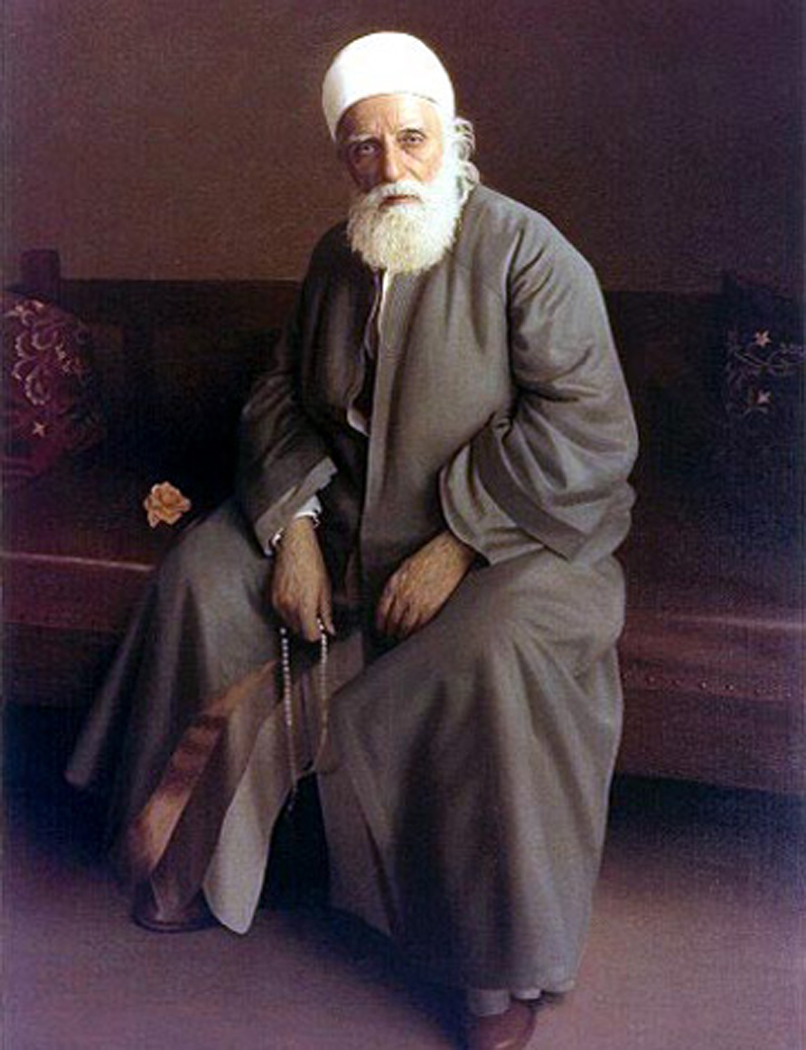
Baha'u'llah pronounced His eldest son,
Abdu'l- Baha, to be ". . .the authorized Interpreter of His teachings, the
perfect Exemplar of His Faith, and the Center of His Covenant with mankind. . ."
(God Passes By, p. 244) |
|
Abdu'l-Baha - Center of The Covenant
Since His childhood Abdu'l-Baha had recognized His father's
station and was His closest companion and protector. From the time of His youth
He actively participated in His father's ministry by assisting with
correspondence, writing religious commentaries, and meeting with religious
leaders.
Throughout His life Abdu'l-Baha was known for His courteous
and gracious manner, His kindness, His love for children, His generosity and His
care for the poor and suffering. He was knighted by the British for the part he
played in alleviating the suffering of the people of the Holy Land during the
1914-18 war, a title he accepted, but never used.
Like His father, Abdu'l-Baha suffered persecution and was
held a prisoner in Akka for 40 years. Still He continued spreading the Baha'i
Faith. He was finally freed from governmental arrest in 1908. In 1911 and 1912
He traveled to Europe and the United States, teaching the Faith at the request
of interested western inquirers and early believers. He, too, wrote many books
and letters and had talks transcribed which today make up part of the scriptural
resources available to Baha'is. Before Abdu'l-Baha died in 1921, He provided for
the continued spiritual leadership of the Faith by establishing the Institution
of the Guardianship.
Abdu'l-Baha, in His Will and Testament, appointed His eldest
grandson Shoghi Effendi to succeed Him as the First Guardian of the Baha'i
Faith. Abdu'l-Baha's Will also delineated many previously unspecified details of
the administrative order. It established the Institution of the Guardianship as
an hereditary office and outlined its essential functions. It provided measures
for the election of a Universal House of Justice, defined its scope and set
forth its relationship to the Guardianship. It also prescribed the obligations
and responsibilities of the Hands of the Cause.
Thus, the Will and Testament of Abdu'l-Baha may be
considered a charter document for the authority of the highest institutions
within the Baha'i administrative order.
|